Real estate brokers do not struggle with ideas or intent. They know their markets, understand their clients, and have a clear sense of how they want to show up professionally.
Where things start to break down is much earlier and much more quietly. It happens during setup.
Launching a real estate website, configuring lead workflows, and setting up communication across the transaction lifecycle still takes far more time and effort than it should. Brokers repeatedly re-enter the same information, adjust templates, rewrite messages, and try to maintain brand consistency across tools that were never designed to work together.
As Artificial Intelligence becomes more common in real estate technology, the real question is no longer whether brokers should use AI. It is where AI can actually remove friction instead of adding another layer to manage.
Increasingly, the answer is onboarding.
The real bottleneck most real estate platforms do not address
Over the last few years, real estate technology has expanded rapidly. Platforms now offer more automation, more integrations, and more features than ever before. On paper, this should translate into efficiency.
In reality, many brokers feel slower, not faster.
The issue is not capability. It is configuration. Most real estate software still requires brokers to manually translate their brand, market focus, and communication style into templates and settings across multiple stages of the workflow. Even when brokers are clear about how they want to communicate, that intent often gets diluted as it moves from website copy to lead outreach to transaction updates.
This is where inconsistency creeps in. It is also where a significant amount of time is lost.
Why AI in real estate has not solved this yet
Much of the attention around AI in real estate has focused on content generation. Writing emails faster or producing listing descriptions on demand can be helpful, but it does not solve the underlying problem.
Brokers still have to set everything up first. They still have to choose templates, define messaging preferences, and revise outputs so they actually sound like them. When AI is layered on top of fragmented workflows, it often creates more work instead of less.
The real opportunity for AI in real estate is not speed at the end of the process. It is clarity at the beginning.
Why onboarding is where context actually exists
Onboarding is one of the few moments when real estate brokers naturally think holistically about their business. At this stage, they are already clear on who they serve, how they differentiate, and how they want clients to experience working with them.
That context is valuable, but it is usually lost once setup begins. Most systems ask for pieces of information in isolation rather than capturing intent as a whole.
This is where AI can be applied in a far more meaningful way. By capturing context upfront and using it to configure systems automatically, AI can ensure that the original intent carries through every downstream interaction.
What AI-led onboarding changes in practice
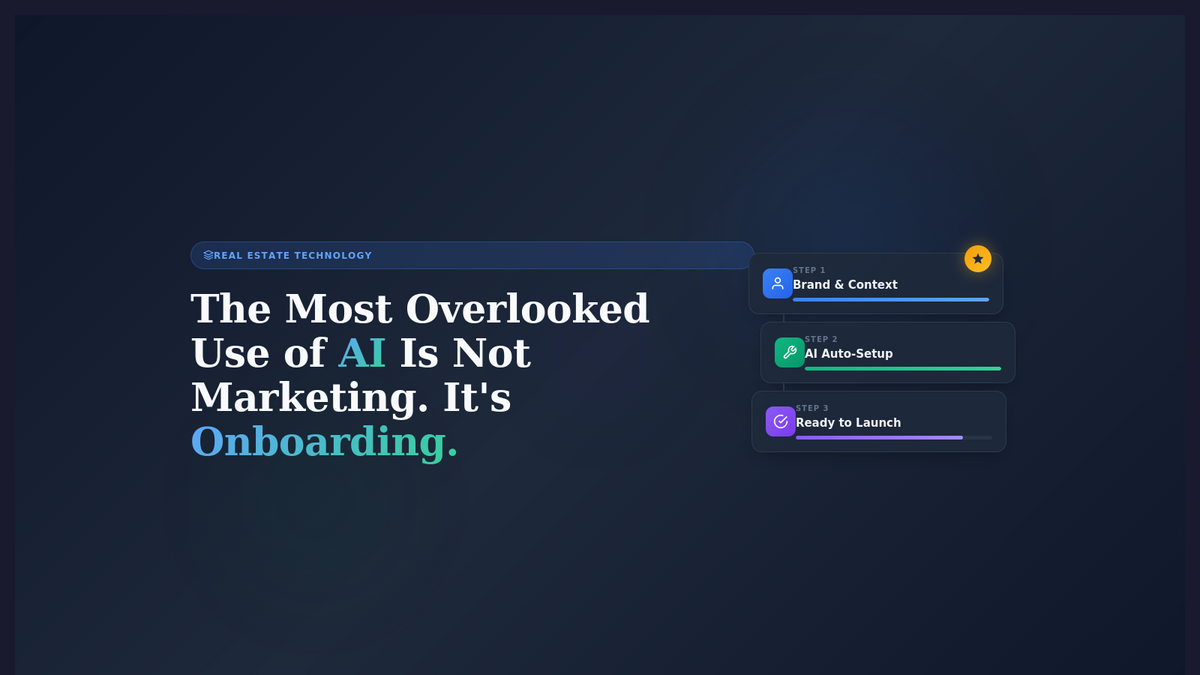
With AI-led onboarding, brokers share a structured set of inputs at the start, covering their market focus, areas of expertise, and communication style. Instead of those inputs being used once, they become the foundation for how the platform behaves.
Website messaging, lead outreach, and transaction communications all reflect the same underlying context. Brokers do not have to repeatedly customize templates or correct tone along the way. The system stays aligned by design.
This thinking is what led the team at EasyDigz to focus on onboarding as the place where AI can do the most meaningful work. Rather than using AI to generate content later in the process, the platform applies AI at the point where brokers are already articulating who they are and how they work.
By capturing that context upfront and using it to configure websites, lead outreach, and transaction communications, EasyDigz aims to reduce setup friction while preserving brand consistency across the entire client journey.
A shift toward upstream personalization in real estate technology
Personalization in real estate technology has traditionally been treated as something that happens later. Messages are adjusted, templates are tweaked, and communication is refined once systems are already live and brokers start interacting with clients.
AI-led onboarding changes where that process begins, not where it ends.
By capturing brand, market focus, and communication preferences during setup, brokers start with a stronger baseline that reflects their intent from day one. That baseline can then evolve over time, shaped by real interactions, feedback, and changing business priorities.
Rather than forcing brokers to constantly rebuild messaging from scratch, this approach creates a foundation that can be refined and adapted as workflows mature. The result is less early-stage friction, fewer inconsistencies, and more room for brokers to focus on relationships and deal execution.
What this signals for the future of broker technology
As expectations around efficiency continue to rise, brokers will increasingly evaluate technology based on how much friction it removes, not how many features it offers.
The most effective AI in real estate will not be the most visible. It will work quietly in the background, eliminating repetitive setup and preserving intent before problems surface.
For real estate brokers, that work starts at onboarding.
EasyDigz recently shared more details on how this approach is being applied in practice with the launch of its AI-led onboarding capability. The full announcement is available here: https://myfox8.com/business/press-releases/ein-presswire/883857619/easydigz-introduces-ai-led-onboarding-to-simplify-digital-setup-and-outreach-for-real-estate-brokers/