Real estate agents are not sitting at their desks ignoring leads. They are not skipping follow-ups out of laziness or indifference. The idea that slow response times stem from lack of effort is one of the most persistent misunderstandings in the industry.
The reality is more structural.
Agents are not responding slowly because they lack commitment. They are responding slowly because the systems they rely on were never designed to support the speed that today's market demands.
The data reflects a deeper problem
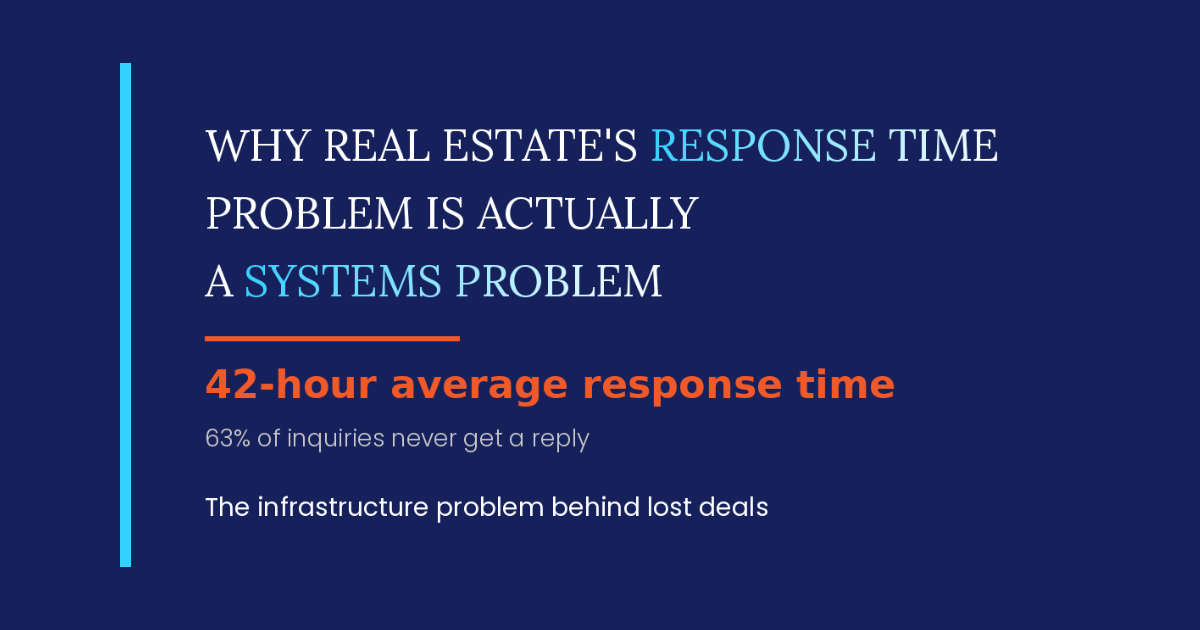
The numbers from EasyDigz's recent webinar on response times paint a clear picture. The typical response time for an online real estate inquiry is 42 hours. More than 63 percent of sales inquiries never receive a reply at all.
These are not the statistics of an unmotivated workforce. They are the symptoms of broken infrastructure.
Nearly half of all online leads now arrive outside traditional business hours. Many come from relocation buyers conducting late-night searches from out of state, often reaching out to multiple agents simultaneously because they lack local relationships. In these situations, speed is not just an advantage. It is the deciding factor.
Seventy-eight percent of transactions go to the first agent who responds. A reply within five minutes makes a lead 21 times more likely to be qualified. A response in the first 60 seconds can increase conversion odds by 391 percent.
The agents who win these leads are not necessarily more talented or more experienced. They are simply the ones whose systems allow them to respond first.
Where the breakdown actually occurs
The issue is not that agents do not want to respond quickly. It is that their tools do not allow it.
Most agents operate across multiple disconnected platforms. A lead comes in through one system. The CRM lives in another. Marketing automation runs separately. Transaction management happens elsewhere. None of these tools were built to communicate with each other in real time.
When a lead arrives after hours or while an agent is with a client, the infrastructure fails. The inquiry sits in one system while the agent checks another. By the time the pieces are manually connected, hours have passed. Often, another agent has already responded.
This is a design flaw.
The fragmentation that exists across most agents' tech stacks creates unavoidable delays. Even agents who are highly organized and responsive find themselves losing leads not because they lack discipline, but because their systems require too many manual handoffs.
Why the market has changed faster than the tools
The expectation for instant responses did not exist a decade ago. Buyers were more patient. Searches happened during business hours. Agents could reasonably expect to follow up the next morning without losing the opportunity.
That environment no longer exists.
Today's buyers expect immediate engagement. They expect it at 11 PM on a Sunday. They expect it while comparing three agents at once. And they expect the first response to be relevant, not generic.
Most real estate technology was built for the old model. It assumes that agents have time to manually triage leads, craft personalized replies, and coordinate outreach across multiple platforms. It was designed for a market where speed was helpful, not essential.
The result is a growing misalignment between what buyers expect and what existing systems can deliver.
What automation actually needs to solve
There is no shortage of automation in real estate technology. Drip campaigns, email templates, and scheduled follow-ups are now standard features across most platforms.
But these tools automate the wrong part of the process.
They help agents follow up after the first contact has already been made. They do not help agents make that first contact in the moments when it actually matters.
The bottleneck is not nurturing. It is the initial response. And most platforms still require agents to manually generate that first reply, even when the inquiry arrives at a time when immediate action is impossible.
This is where automation should be applied. Not to follow-up sequences that happen days later, but to the first 60 seconds after a lead arrives.
What real-time response requires at a systems level
Responding in real time does not mean agents need to be awake and available at all hours. It means the system needs to act on their behalf the moment an inquiry comes in.
That requires several things to happen simultaneously. The lead needs to be captured and logged. The system needs to understand what the buyer is asking for. It needs to generate a response that sounds like the agent and addresses the specific request. And it needs to route that response immediately while triggering the appropriate follow-up workflow.
This cannot happen across fragmented tools. It requires integration at the platform level.
When these systems are consolidated, the friction disappears. An inquiry arrives. The platform reads it, matches it to relevant listings or information, and sends a personalized reply within seconds. The agent is notified. The conversation begins before the buyer has moved on.
This is not a hypothetical capability. It is what platforms built for modern workflows are already doing.
The shift brokerages are starting to make
Brokerages that have modernized their response infrastructure are not doing more work. They are doing less.
By consolidating lead capture, CRM, and automated outreach into a single system, they have removed the manual handoffs that create delays. Agents no longer lose leads because they were in a showing or asleep when the inquiry arrived. The system handles the first contact automatically, and agents step in once the conversation has already started.
This is not about replacing agents. It is about building infrastructure that works at the speed the market now requires.
The agents who benefit from this shift are not different from those who do not. They simply have access to systems that were designed for the realities of today's real estate market rather than the assumptions of the past.
Response time is not a performance issue
The response time problem in real estate is often framed as a behavioral challenge. Agents are told to check their leads more frequently, respond faster, and prioritize follow-up.
That framing misses the point.
The issue is not effort. It is infrastructure.
When systems are fragmented, delays are inevitable. When tools require manual coordination across platforms, speed becomes unsustainable. And when automation is applied to the wrong part of the workflow, the bottleneck remains.
The brokerages that will succeed in the coming years are not the ones that work harder. They are the ones that remove the structural barriers that make fast response impossible in the first place.
For agents and brokerages still operating across disconnected tools, the path forward is clear. The problem is not motivation. It is a system. And systems can be fixed.
EasyDigz recently shared insights from a webinar on how response delays are affecting lead conversion and what brokerages are doing to modernize their first-contact systems. The full details are available here: https://www.cbs17.com/business/press-releases/ein-presswire/888587790/slow-response-times-are-causing-agents-to-lose-deals-before-contact-even-begins-says-easydigz-webinar/